
Enrichment
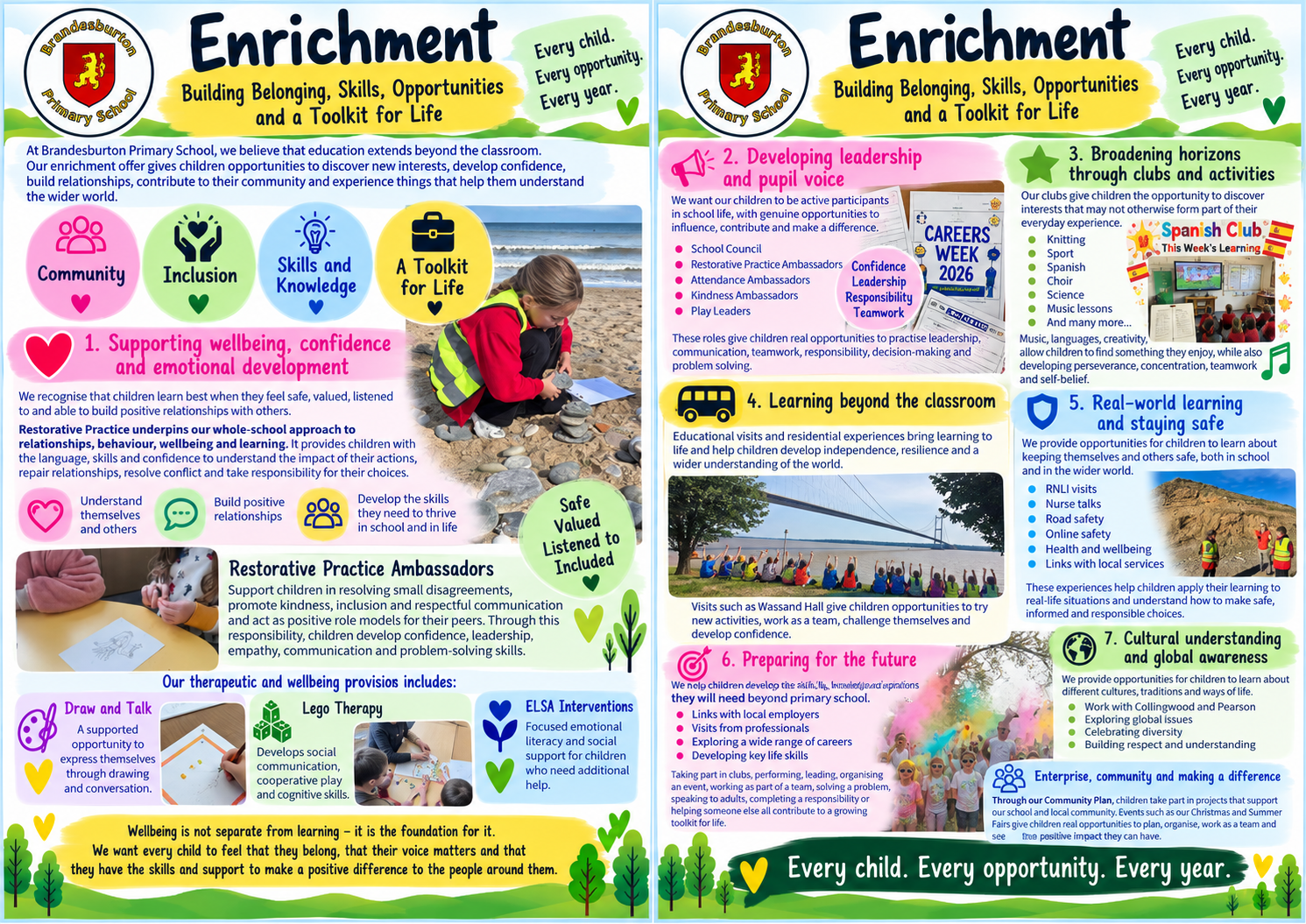
Enrichment: Building Belonging, Skills, Opportunities and a Toolkit for Life
At Brandesburton Primary School, we believe that education extends beyond the classroom. Our enrichment offer gives children opportunities to discover new interests, develop confidence, build relationships, contribute to their community and experience things that help them understand the wider world.
Our enrichment programme is closely linked to four drivers:
Community, Inclusion, Skills and Knowledge and building a ‘Toolkit for Life’.
Our curriculum already places a strong emphasis on first hand experiences, interpersonal skills, resilience, creativity, critical thinking and developing children who are ready for life beyond Brandesburton Primary School
This approach strongly reflects the Department for Education's Enrichment Benchmarks, published in 2026. The benchmarks describe eight characteristics of a high-quality enrichment offer: strategic alignment; breadth; communication and celebration; pupil and community voice; accessibility; partnership; outcomes; and continual improvement.
At Brandesburton, enrichment is not an 'extra'. It is part of how we help children develop the experiences, confidence and practical skills they will need throughout their lives.
Our enrichment offer is built on a simple principle: when children feel that they belong, they are more willing to participate, take risks, develop new skills and contribute to others.
1. Supporting wellbeing, confidence and emotional development
We recognise that children learn best when they feel safe, valued, listened to and able to build positive relationships with others. At Brandesburton Primary School, Restorative Practice underpins our whole-school approach to relationships, behaviour, wellbeing and learning. It is not simply a response to conflict or incidents; it is embedded within our everyday school culture and provides children with the language, skills and confidence to understand themselves and others, manage relationships, resolve difficulties and take responsibility for their choices.
Through our restorative approach, children are encouraged to listen to others, express their feelings appropriately, consider different perspectives, understand the impact of their actions and work collaboratively to find positive solutions. This creates an environment where children feel heard, valued and included, while developing the interpersonal skills they need to learn successfully and contribute positively to school life. Restorative Practice therefore forms a key part of our ‘Toolkit for Life’, equipping children with skills that extend far beyond the classroom.
Our Restorative Practice Ambassadors play an important role in developing and modelling this culture across school. They support children in resolving small disagreements, promote kindness, inclusion and respectful communication, and act as positive role models for their peers. Through this responsibility, children develop confidence, leadership, empathy, communication and problem-solving skills, while recognising that they have an active role to play in the wellbeing of others and the wider school community.
Alongside Restorative Practice, our whole-school curriculum provides planned opportunities to develop wellbeing, confidence and emotional understanding. Through Jigsaw (PSHCE), children learn about healthy relationships, feelings, personal identity, resilience and making safe, respectful choices. Our Religion and Worldviews (RE) curriculum encourages children to explore beliefs and values, ask thoughtful questions, appreciate different perspectives and develop empathy and respect for others.
This whole-school approach is complemented by targeted therapeutic and wellbeing provision. Draw and Talk provides children with a supported opportunity to express themselves through drawing and conversation; Lego Therapy develops social communication, cooperative play and cognitive skills; and targeted ELSA interventions provide focused emotional literacy and social support for children who need additional help.
These messages are reinforced through whole-school assemblies and class circles, where children revisit themes from Jigsaw and other areas of learning, discuss issues that matter to them and practise listening and expressing their views. Each class develops a class charter, establishing shared expectations and a sense of responsibility and belonging. Children can also contribute to school life through roles such as School Council members and Restorative Practice Ambassadors, explored further in Section 2.
Together, these approaches ensure that wellbeing is not seen as separate from learning, but as a foundation for successful learning, positive relationships and personal development. We want every child to feel that they belong, that their voice matters, that they can overcome difficulties and that they have the confidence and skills to make a positive difference to the people around them.
2. Developing leadership and pupil voice
We want our children to be active participants in school life rather than simply recipients of opportunities.
Children can take on a range of meaningful leadership roles, including:
- School Council
- Restorative Practice Ambassadors
- Attendance Ambassadors
- Kindness Ambassadors
- Play Leaders
These roles give children genuine opportunities to practise leadership, communication, teamwork, responsibility, decision-making and problem solving – the chance to influence school life, rather than simply holding a title.
Pupil voice is also used to shape decisions across school, not only through formal leadership roles. We listen to children through discussions, class circles, School Council and other opportunities to share their views. Their feedback helps inform choices such as the after-school clubs we offer and adaptations to curriculum experiences, so that provision reflects their interests, needs and experiences.
Our aim is that children learn that leadership is not simply about having a title. It is about noticing what needs to be done, working with others and having the confidence to make a positive contribution.
3. Broadening horizons through clubs and activities
Our clubs give children the opportunity to discover interests that may not otherwise form part of their everyday experience.
Clubs are selected and reviewed using parent questionnaires, pupil voice, staff interests and strengths, and opportunities we want children to experience before moving to secondary school. This enables us to offer a balance of familiar favourites and activities that broaden horizons. For example, Spanish Club provides an opportunity to explore an additional language and develop confidence in communicating in a new way.
Our enrichment offer includes opportunities such as:
- Knitting
- Sport
- Spanish
- Craft
- DT/Art
- IT
- Gardening
- Choir
- Science
- Music lessons
- Other clubs and activities developed in response to children's interests and school priorities
Music, languages, creativity, sport and practical activities allow children to find something they enjoy, while also developing perseverance, concentration, teamwork, communication and confidence.
For some children, enrichment provides the opportunity to discover strengths, interests and talents that may not always be visible with the classroom.
4. Learning beyond the classroom
We believe that some of the most memorable learning happens when children experience the world first-hand.
Our trips and visits range from local experiences to opportunities further afield, helping children understand their local area while also broadening their horizons.
Our local community is an important learning resource. We draw on links with families, including opportunities to visit local farms, helping children understand rural life, agriculture and the work of people in our community. We also make the most of our location in a village close to the coast, nearby towns and the city of Hull with its fishing and industrial heritage. These different settings provide meaningful contexts for fieldwork, visits, local history, geography and discussions about how places and livelihoods change.
Children have opportunities to experience:
- Local community visits
- Educational trips
- Experiences further afield
- Residential Visit to experience Outdoor Adventurous Activities
- Writing and cultural events
- Collaborative music events and competitions
- Visits and activities connected to the curriculum
- Opportunities to meet people with different experiences and expertise
- Linking classrooms with primary schools in opposite contexts (Collingwood and Pearson Primary)
Examples include:
Our writing event at Wassand Hall, where children can experience writing and creativity in a different environment and connect their learning with a real place and its history alongside 17 other schools from across Hull, North Yorkshire and East Yorkshie.
Collaborative Music Events such as Big Brid Sing and the HCAT Opera Event allowing the children to learn songs within school to then perform together with other schools in a performance venue such as Bridlington Spa.
These experiences help children build cultural capital, curiosity and confidence while developing memories that become part of their wider educational journey.
5. Developing safety and real-world knowledge
Enrichment also gives children access to adults and organisations who can share knowledge and expertise that complements classroom learning.
Examples include RNLI water-safety education and nurse talks, providing children with opportunities to learn about staying safe, health, responsibility and the world beyond school.
Online and digital safety are an integral part of our computing curriculum and are revisited regularly in every year group as children become more independent users of technology. Teaching supports children to recognise risks, seek help, communicate respectfully and make informed choices online. We also work closely with local police and Police Community Support Officers (PCSOs), who visit school, contribute to assemblies and share current safety messages with staff so that these can be reinforced with children.
These experiences help children make connections between what they learn in school and the situations they may encounter in everyday life.
Practical road safety is also supported through opportunities for bike and scooter training during children’s time at Brandesburton, helping them develop awareness, confidence and safer habits when travelling in the local community.
6. Careers and future aspirations
We want children to understand from an early age that there are many different pathways, jobs and possibilities available to them.
Careers Week (which is an annual event held in summer for the whole school for two weeks) gives children opportunities to meet people, hear about different occupations and begin thinking about the skills that different jobs require.
Throughout the year, we seek opportunities to connect children with authors, artists, sports teams and inspiring individuals. Subject to availability and curriculum links, these may involve assemblies, workshops, visits or talks. We also give communication and writing a real purpose wherever possible, for example by encouraging children to write letters or questions to people, other children in other schools and organisations. This helps them recognise writing as an important life skill: a way to ask, thank, persuade, enquire and make meaningful connections beyond school.
We also want children to understand that the skills they develop through enrichment have real value beyond primary school.
Taking part in clubs, performing, leading, organising an event, working as part of a team, solving a problem, speaking to adults, completing a responsibility or helping someone else all contribute to a growing toolkit for life.
Where appropriate, children are encouraged to apply for leadership and responsibility roles. This can include completing job applications and thinking about the qualities and skills they can bring to a role.
These experiences introduce children to concepts such as communication, responsibility, teamwork, application, perseverance and interview-style thinking in an age-appropriate way.
7. Building cultural understanding and working with others
We believe children should have opportunities to learn with and from people beyond their immediate school community.
Brandesburton works with other primary schools, including Collingwood and Pearson, both based in Hull, to create opportunities for children to develop cultural understanding, share experiences and appreciate different perspectives.
As a community school, we maintain strong links with our local church. Children contribute to church displays and participate in community events and seasonal celebrations, including Harvest, Christmas and Easter, providing opportunities to understand local traditions, contribute to shared occasions and feel part of village life. We are developing links with other faith communities to broaden children’s experiences and deepen their understanding of different religions and worldviews. This is an emerging area of our provision that we intend to build on over time.
Working collaboratively with other schools helps children understand that people can have different experiences, backgrounds, ideas and traditions while still having much in common.
This is an important part of developing respectful, inclusive citizens who are confident interacting with others.
8. Enterprise, community and belonging
Our Christmas and Summer Fairs provide valuable opportunities for children to experience enterprise and community participation.
Children can contribute ideas, help organise activities, communicate with others, solve practical problems and understand that events require teamwork and planning.
These experiences develop practical skills while strengthening the connection between school, families and the local community.
Our Community Plan provides a structured programme of personal development opportunities across the school. Projects are designed to give children meaningful opportunities to apply what they have learned in real-life situations.
Opportunities have included, litter picking in our local area, filling Christmas shoe boxes, contributing to displays in the church and many other events for the local community.
The purpose is simple: we want our children to feel that they belong, that they have something to contribute and that they can make a difference.
9. Our enrichment outcomes
Across all of these opportunities, we are working towards a common set of outcomes.
We want children to develop:
Belonging – feeling connected to their school, peers and local community.
Confidence – having the courage to try something new, speak to others and take on responsibility.
Communication – listening, speaking, collaborating and expressing ideas.
Leadership – taking responsibility and helping others.
Resilience – persevering when something is difficult or unfamiliar.
Independence – making choices and managing increasing responsibility.
Cultural awareness – understanding and appreciating experiences beyond their own.
Future skills – developing the teamwork, problem solving, creativity and communication needed for life and work.
Community responsibility – understanding that everyone has a role to play in making their community a positive place.
Our Commitment:
At Brandesburton, our ambition is that every child has the opportunity to experience enrichment.
We want children to leave our school with more than knowledge. We want them to leave with memories, interests, relationships, confidence, practical experience and a growing understanding of themselves and the world around them.
Our enrichment offer helps children discover "I can", "I belong", "I can contribute", "I have a future."
Through therapeutic support, clubs, leadership, trips, cultural experiences, careers, enterprise, partnerships and community activity, we are building a toolkit for life – giving our children the experiences and skills they need to flourish in school, in their community and in the future.

